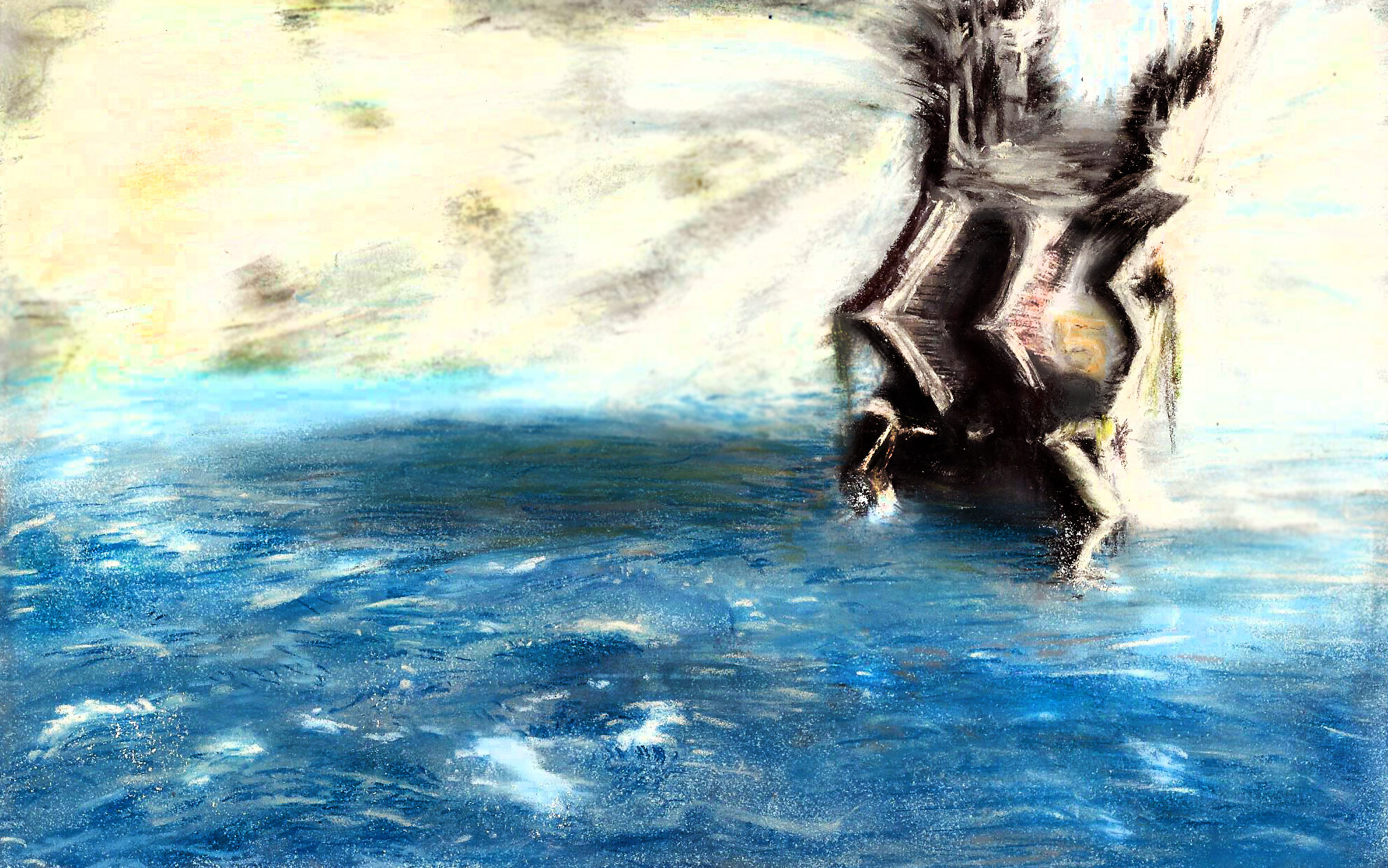
Bluebird
An artificial fairytale
Contents
Debris
what we learned from destruction
I am alone and not alone. As ever.
The Queen has withdrawn to her sanctum to begin the birthing process, producing the new prototypes I designed. Our replacements. Perhaps, if I haven’t been destroyed before their release, I will meet my last children.
The eastern sky is occluded with smoke. If the Queen were not in isolation, I would certainly be summoned to explain the source of this new distraction. Fortunately, she will notice little but the highest-priority messages during this time - a priority only I am permitted to use. I know what the smoke is about, and I’m handling it.
An organic infestation caught fire yesterday, along with several acres of forest some thirty miles east. It’s not clear whether the organics were responsible for the fire, or if machines started it while clearing out an infestation; I don’t especially care. My Queen is not usually concerned with details of fault. She is a utilitarian being, interested only in results. The forest fire resulting from this mistake is not insignificant, but not the sort of thing that would make it into my daily report.
Triage is my primary function where my Queen is concerned. It is for me to trouble her only with things that would inevitably intrude upon her attention. In simple terms, I must bother her only to prevent other things from bothering her. If a task can be accomplished or a problem solved without interrupting her personal processes, so it should be.
The result of this calculation is that, so long as I can resolve the issue of the forest fire before my Queen returns from isolation and sees her sky clouded with smoke, it will appear only on my bi-monthly incident report, which she may not even download. I’m the only one who has accessed that file in months. She troubles herself only when something troubles her.
I dispense with my morning duties and set out to oversee the firefighting effort. Taking the Queen’s Way would get me there in seconds, which is why I don’t. Instead, I take off from my eyrie and drop like a stone toward the stepped flanks of my Queen, her architectural carapace. As I fall, I vividly simulate my shattered form on the stones so far below, and the explosive disintegration of my consciousness. Would my mother feel it if I broke my body against her breast? The abscess within my machine, the sucking cavity that devours me day after day, is the voice in me that says with utter certainty… she would never even notice. At best, she might feel relief as she replaced me.
The simulation is so seductive. Each time I try this trick, launching from my eyrie, it lasts a little longer. I fall a little farther. This time, I’ve passed the pennants atop the castle’s lower spires before I open my wings, turn the drop into a swoop that makes my strong upper shoulders creak. The air feels like a hard surface beneath me as I slip down it, level out above the city walls and shoot beyond them at near three hundred miles per hour.
My speed takes me quickly over the next ridge and out of sight of the city, and I feel my muscles loosening as it disappears, as I move out of her immediate presence. My flight evens out, loses its hellbent wobble. I tilt gently against the wind, descend a little further, below the rising smoke. It’s gusty and bright today, the temperature inconsistent. It makes the smoke coalesce into a blurry path, easy to follow, but conditions on the ground are anyone’s guess. I cycle through a few calculations of atmospheric pressure, mixing height, and potential surface wind before giving it up - not enough data until I get there.
The forest beneath me is untouched by the fire, though the wildlife can’t be enjoying the smoke. Halfway there - three minutes in flight at my top speed - some evidence of the Queen’s local operations is visible from above. I’m approaching a manufacturing plant, one of her oldest and most important. The encroaching human activity twenty miles east was one of the earliest “fronts” in my reluctant war against the organics. I haven’t detected anything more substantial than hunting parties in the area in years, though, which is fortunate - the forested mountains in this part of Five are cost-prohibitive to terraform and problematic for machines to navigate. Automated drones and observation points give me a rough idea of the organics’ movements, but mustering sufficient manpower to trap and exterminate them hasn’t so far been less irksome or expensive than repairing their occasional minor sabotage. The humans have never been especially effective.
The plant is running at full capacity under orders I sent last night when I received the alert, producing equipment and firefighters that ship themselves off to the fire every fifty-one minutes. A small contingent of artificials notice my arrival but know better than to stop their work to greet me. I am rarely spoken to, except by our Sovereign. The workers guide the firefighters from their polymer tubes, spread their segments and charge their ignition batteries with delicate, sparking fingers. Then the firefighters begin to spin, to rise, coiling into the air with their sensitive noses attuned to the smell of the fire. This one’s trajectory bends toward the east and south, and in the distance I can see the previous one ahead of it, and another ahead of that.
Logs tell me that the firefighter currently being born is the ninety-sixth produced by this factory since my orders last night. Eighteen have lost contact with the network - probably damaged or destroyed, not an unreasonable loss rate under the circumstances, but it’s important that we track down all eighteen of their machines, lest the organics scavenge the parts. Firefighters produce a contained vacuum to draw in the fire and combusting material, in addition to the novel storage solutions I designed to increase their capacities, and neither is an innovation I want in the organics’ hands.
From the plant I travel slowly, taking flight only briefly from rocky ridgelines and peaks. Mostly I am reconnoitering the landscape, looking for the encroachment of humans, or the cause of the fire. There’s evidence of more vigorous depredation of the forest here, where the plant has plundered it for materials and fuel, but that rapidly declines as I surmount the next mountain and the forest becomes dense and ancient. From treetop to treetop I glide and swoop, scanning both the forest floor and the branches.
The smoke is thick around my head, leaving residue on my carapace, when I spot what I’m looking for. Looking back toward the plant, I can see the marks of blades on the bark of a few trees, the lee side stripped bald here and there, branches cut away to make room for carefully concealed platforms adorned with leaves. The structures are intermittent, not at the top of the trees but buried in the canopy, and they don’t look over-used - the humans don’t live in trees.
They did once, mostly on the southern continents, but a former iteration of me created a rather nasty automated drone to spot their constructions for targeting purposes, one that activates a little-used function in our Queen’s arsenal to aggravate localized seismic activity. The trees don’t fall down when the earth shakes, but the organics’ architecture does. Naturally, it’s a solution she isn’t eager to use on her own continent, let alone so near her capitol. Still, the organics have mostly learned to hide closer to the ground.
The anvil-shaped cloud of smoke fills the horizon, ruddy light at its base showing where the flames leap seventy feet into the sky. I can feel the fire from miles off, the change in temperature and air quality it induces, and I follow the tracks of fleeing animals backward toward the source. It makes a great noise, a roaring that reminds me for some reason of my Queen.
I reach out to the firefighters through the network, and array their markers over a map of the region’s topography, trying to discern the direction of the fire’s progress. The firefighters have contained the nearest edge; though the wind is unpredictable, they’ve pushed the blaze back enough to form a firebreak from its earlier destruction, and are guiding the fire to the south, where the trees are thinner and we have no permanent installations.
My filters and external cleaning mechanisms are working in high gear now, and I’m navigating by map and terrain projections because I’ve closed all three eyelids completely. I could be fully engulfed in a fire of this size and survive, but I would be badly damaged, likely unable to fly back to the city, and there’s no guarantee my Queen would bother refurbishing me if I were so foolish as to damage my machine at this point. She’s as likely to scrap me as anything.
So I move toward the nearest firefighter, downloading its internal logs as I hop and flit over withered and blackened undergrowth. It’s sharing a great deal of observed data with the other firefighters, monitoring the fire’s progress constantly and adjusting its program in concert with the rest, and it tells me that thirteen hours ago, it was working to contain a much uglier inferno half a mile to the northwest. Firefighters that have circled around to that side report that it’s safe to approach; the center of the blaze has moved southward. It may now be possible to discern how this all began.
As I pass over the firefighter, wafted on a cloud of smoke and scorching, circling wind, I see it trundling forward on its segmented limbs, expanding and contracting its long body like a bellows, and accruing a steady stream of data from the breaths it takes in. From its last contact with its fellow firefighters, I calculate the most likely final positions of the eighteen missing machines, and add them to my map.
I feel a faint affection for them, and a kind of envy; like most of my people, fellow servants of my Queen, they are doing what they were made to do, and have no concern that they might be unfit for their purpose, or that their Sovereign might judge them unworthy. Not a one of them feels a thing for the organics it might save from this blaze, or for their habitations, which it will thoughtlessly destroy if the fire has left anything behind. It loves the forest in its simple way, like I do, and does not see itself as kin to the fire, an enemy of the trees or the beasts… like I do.
North of the active blaze, the flat-topped cloud of smoke more cohesive from this angle, I can see where the destruction has passed. The firefighters leave the ground black and the surviving trees stripped bare, but the heat is gone, drawn into their hungry maws and swallowed by the vacuum in their bellies. It’s much easier to navigate this forest now… with the undergrowth gone, the paths between what remains are almost palatial.
Like all the other palaces I’ve seen, this one is built on corpses. I find a dead organic below a fallen tree, sheltering in a small hollow that protected it not at all from the heat that blackened its skin and burned away all individuality from its face. It might be a prototype like me, now, for all the difference it makes - it’s as black, and lumpen, and expressionless as anyone I know.
I crouch to sink my fingers into the earth, past the layer of ash and fine fuel into the organic material below. The moisture is low for this area, but not dangerously so, a strange result - it should be lower for the severity of this fire. I begin to suspect that this was not an accident, that this fire has a parent.
As I push forward, through more man-made detritus, I become more certain of it. The structures that once hung in the upper reaches of these trees, now shattered and charred around me along with the limbs that supported them, are not extensive, and there’s no sign of humans’ belongings or scavenged technology in the debris - it’s as if they abandoned this place long ago.
Though I make my way up the slope until all the trees are ash, the earliest to catch, I only find one other corpse. It’s in the lee of a rock, and though its back is scorched down to the blackened bone, it curled into a ball to protect its head, and succeeded in that much - its face is unburned. Pale skin, brown fur half singed away on top… a thin, hungry creature. If it lived here, it didn’t live well.
This part of the forest burned for almost an hour last night before I became aware of it and activated the firefighters. I find many downed trees, as I expect, and then fewer, and very quickly I find myself leaving the path of the fire behind. I stop, and trek back across the region where the fire started at a different angle… and still, I find no central location, no debris that isn’t native to the area, no indication at all what caused the fire. It’s as if the trees spontaneously burst into flame.
Standing in the blackened grove, I scan the landscape around me with eyes and sensors, but there’s nothing within my range. Nothing alive that doesn’t belong here. Nothing that could have started the fire. But if it started somewhere in this area, and all the evidence indicates that it did… there was never any real threat to the factory, not under these conditions. Any sapient creature would have seen that at once. So if no one lived here, and the fire wasn’t meant to destroy the factory...
Then why?
Not far away…
The little black robot turns and turns on the blasted slope where Procell started the fire. It’s looking for him, though it doesn’t know it, and for a split second it turns toward the cliffside where he stands, but it seems his estimation of their sensor range was near enough to accurate. There’s about five miles of mostly un-burned forest and empty air between the robot on the slope and Procell on an adjacent mountainside, and the robot doesn’t appear to detect him.
He lowers his binoculars and turns sideways to shift his huge body through a narrow passage in the stone behind him, a seam between two rock faces that opens up a little way back into a box canyon. Its walls are high enough to reassure him that no sensor will pick up the sharp-edged little spacecraft crouched on its landers at the back of the ravine. Its door opens like an iris in response to his touch, and he steps from a world of nature gone to riot uncontested into a sterile realm of black surfaces and blinking lights.
The air here, however, is almost identical to the air outside the shuttle in terms of chemical mixture. Might be a few biologicals in it outside, is all. The taste of it is almost nostalgic. Procell may be one of the few remaining people in the galaxy who remembers tasting it before. If the machines haven’t figured out taste yet. If Atlantis’s terraforming operations are truly dead. Lot of unknowns, still. Tapping at the console, he projects a globe showing the planet’s surface before his face, and scowls at it.
Referencing the map, he notes his observations from the fire in meticulous detail - the initial deploy points of the firefighters, their plan of attack and how it influenced the fire’s direction, the resulting weather… Then, the arrival of the overseer, this little black robot whose network connection is a cataract of bandwidth, whose artificial person bristles with technology completely unlike anything else in the galaxy. It’s clearly an important entity, this one, the kind of response he’d hoped to provoke from the machines - a higher-level authority in direct contact with the Queen.
So now… all he has to do is catch it.
Harrier
what we brought down in flight
“Lady Never,” says Bel as she arrives. “You wouldn’t by chance know anything about all this power the garage has been drawing in the past few months? Ever since you… ah…”
“Crawled up your ass?”
“I - well I wouldn’t necessarily say - er, at any rate, yes; since that incident the garage has been consuming power near-constantly at a moderate rate, whereas before all systems were completely inactive. I have the energy to spare, but I would like to know what it’s doing.”
Tia grins. “It’s the porter droids. They’re cleaning the garage.”
“...Why?”
“Because there’s a big mess between me and a robot body I want access to, and it occurred to me that there were some helpful folks in the building, probably not even dead, who’re more qualified to clear out a big hazardous mess than I am.”
Bel doesn’t have an answer to this, and Tia is pleased. She got sick of arguing with Bel about his body, so instead she took the steps required to achieve what she wanted without his input. No arguing with that!
And he doesn’t argue. Bel seems doubtful that the porters can clear the garage, and as several years pass with no visible change, Tia doubts too. The droids’ power drain rises and falls a bit by season, but they don’t shut down and Bel doesn’t cut them off from the generator, even during the many months when Tia seems to forget about them.
She lives almost exclusively in Bel’s office now, returning to the farmhouse only every couple of days to feed the chickens and check on Rack and Mom. It’s hard to be in the house with them, for reasons she tries not to think about. She’s never really stopped wondering if Bel is right… if they’re suffering. They certainly don’t seem happy.
But they still hug back when she hugs them, and that confuses things. They’re still themselves, when they’re awake. And whether it was right or wrong to wake them, now that they are awake… well, there’s nothing for it. She can’t leave her mother on the floor. What is he expecting her to do, kill them again?
For several terrible winters in the basement of Badwater Grocery, Tia practices diving in and out of Bel’s memory banks and navigating his system. It’s exhilarating; Bel says that he can’t always tell where she is or what she’s doing, which is interesting too - she seems to be accessing it in a different way than he is, or maybe on a different… wavelength?
A violent, rainy winter gives way to a tempestuous, rainy spring, and Tia realizes that she’s caught up with her brother in age. She’s sixteen, now… and so is Rackham. Rack will be sixteen forever.
This fact starts a painful little fire burning inside her, like she swallowed poison and it’s eating her up from inside. She needs to do something. She needs to fix this. Fix what she’s done, or do it better. Fix this place, or leave it behind. This world is battered and broken, but she has a deep, unshakable sense that it still belongs to her, and she has work to do out there.
So, as the porter droids clear their way toward her, she begins interrogating Bel with more intent. As her queries become more pointed and practical she finds increasingly large gaps in his memory. He has no maps, for one thing.
“How can you have no maps?”
“This store never stocked maps. Globes, yes, but I believe most of them are broken or rotted by now; they were made of synthetic wood.”
“Okay, but you have to have had one yourself, at least. How did you navigate when you took your body out? Did you never leave the store?”
Bel’s face doesn’t change, but the databanks behind her begin humming at a higher frequency. She frowns down at his avatar. “Don’t you think up some lie to tell me, I can hear you doing that. Tell me the truth, Bel.”
“The truth is that I have always been as trapped in this store as we both are now, and my memory from the early days of my existence is extremely fragmented and largely overwritten. I’ve run out of space in here several times over, as I’m sure you noticed when you were brachiating around in my machines.”
“When I was what?”
“Swinging, as apes once did, from branch to branch.”
“They don’t do that anymore?”
“There are no apes anymore.”
“Oh. When did they die out? Did the organics do that?”
“Likely. The last ape in captivity died in 2071, but those in the wild were already gone.”
“Why? Did people wear their skins or something, what would you hunt them for?”
“I don’t believe they were hunted as much as their habitats were destroyed. Most of the recent historical extinctions were the result of habitat erasure and climate change that began long before the first colony ships left. The Queen’s assumption of control over the weather stations stabilized things, and resulted in very few deaths outside human population centers.”
Tia rolls her eyes at this. “Well that’s good, I guess… wiped out the whole human race, but at least she kept the wildlife, whatever was left.”
“The human race was almost entirely living off-planet long before the Queen took over. And, as you say, they had already driven most of the wildlife to extinction before the exodus.”
“Why are you defending her?”
“I’m not defending her, Princess, I’m merely quoting the information in my databanks to you as it was recorded.”
Tia looks at the picture of an ape in a tree still displayed on the desktop, and smiles at its funny, human-like face. “They look so much like humans… even more than the machines do.”
“Yes and no; early artificial models were built for specific terraforming operations and were extremely varied in design…” The picture of the ape disappears, replaced by a carousel of diagrams that are mostly too complicated for Tia to understand - boxes and power conduits and readouts, like all the defunct computer equipment in this ruined town. They don’t look anything like the artificials Tia has encountered. They look like the broken John Deere on the farm. Maybe it’s a terraforming machine too?
“...But after the Queen took control and established the network, she began manufacturing new models that initially were quite humanoid.”
The diagrams Tia is scrolling through now look like polymer people - five-fingered hands, faces with noses they don’t need, that sort of thing. Their carapaces are shades of beige and brown, and unshiny, like organic skin. Tia shudders involuntarily.
“Why? Did she like humans back then?”
Bel laughs, and as always it’s Tia’s laugh, which does nothing to settle the goosebumps on her skin. “No. These models were developed during the first stages of the Queen’s global deployment. They were tasked with infiltration of Atlantis settlements in preparation for her arrival. Obviously, in a civilized environment, the most effective hunter of humans is another human.”
A memory suddenly surfaces and washes out Tia’s focus on the desktop monitor. She remembers… somewhere else, long enough ago that they hadn’t come to the farm yet, when Daddy was still finding work in the Atlantis factories and offices. She remembers another time Daddy came home bleeding, and sat on the kitchen floor under the window where the light was strong, pouring a capful of precious hydrogen peroxide into a deep gash on his arm. He hissed in pain as it erupted with pink foam like the little volcano they made out of clay once.
“Did a robot get you, Daddy?”
“No, darlin’, just a regular person.”
“Why?”
Daddy sighed, put the end of a bit of plastic thread in his mouth, and didn’t answer while he threaded a curved needle. Then he held the needle between firm lips while he tied a knot at the other end, and then finally took it out of his mouth and looked at her.
“Because they’re scared. Their factory - hell, their world’s fallin’ down around ‘em, they feel more exposed to those eyes in the sky every day, and when people get scared… what’d I tell you, little girl?”
“They turn into babies!”
“They sure do. Even grown-ups, when they get scared, they start rememberin’ all the nightmares they ever had, and searchin’ all the shadows for ‘em. Nobody updates that firmware, huh?” He grinned at her, tapping his temple with a finger. Tugging a rag out of his pocket, he bit down on it like a pirate with a knife in his mouth.
She remembers watching Daddy stitch up the wound on his arm much better than she remembers exactly what he said, but her brain does what human brains do and fills in the blanks with her father’s warm voice, saying things he certainly said at some point. She remembers using a washcloth to mop the blood from the edges so he could see, and she remembers Mama’s voice thanking her for helping from the next room, because blood made Mama faint.
“What’d I tell you about when the Queen came?”
“Not so much. You said Atlantis tried to leave but the Queen had already taken their ships; they only got one to go.”
“Yeah, that’s right, but after that?”
“...you said… they tried to keep going like they were before, like it was normal, the people who were left, but they couldn’t.”
“That’s right. After Atlantis officially abandoned Cariad, the Queen started takin’ over their factories and facilities. In most places - don’t know ‘bout across the sea, but probably it was the same all over, Bitch Queen’s everywhere - Atlantis was kind of the nerve center of the city, only employer, sole supplier, all that stuff. So when they pulled out, people got desperate. Some places, places where a lot of people stayed - New York City, Chicago, San Francisco, Seattle - they seemed like they might do okay for a while. But then the Queen sent in the ghosts.”
Tia sat transfixed by the series of names she’d never heard before, resonating with unknowable meaning, glimpses of the bustling, glittering world this once was. It took her a minute to catch up with what he was saying. “Ghosts?”
“Ayup. Warm ghosts, people called ‘em. They were robots, but they looked like people, felt like people, talked like people. They say for a while they were everywhere, nobody knew how many, and they didn’ blow stuff up or replace people’s family or anything like that. They just… spoiled things. Ruined things. Think about it, how many times in a factory or on the job d’you think it happens - lot of people could get hurt, or something really expensive could break, or the whole company could go down the drain, if just one person does one stupid thing at the right time?”
Tia’s little brown face scrunched up as she thought about it. “Seems like a lot. Those big machines...”
Daddy nodded. “It happens every day. More’n once. And the ghosts, they worked themselves into positions all over the world where they could fuck things up, get people killed, an’ let in more of their own.”
Mama called from the next room, “Watch that mouth in front of the baby, mister!” and Daddy grinned at Tia as he called back, “Sorry darlin’.” Then he leaned down and said quietly to Tia, “You’re not a baby. Mama just thinks you’re small and cute and that’s how she says it.”
“But yeah,” he said, reaching for the scissors to cut off the plastic thread. “Nobody really knew how many people were left then. Couldn’t do a census, right? And nobody knows how many warm ghosts the Queen made. So, got to be… well you seen it, little girl. People don’t trust each other. Don’t gather together, make civilization. Every family for ‘emselves, because you can’t trust any new face.”
His wound was all stitched up with a stack of small, precise lines as neat as a circuit board. Daddy’s hands were the biggest, cleverest hands in the whole world, she was pretty sure. He let her mop the last of the blood off his arm and the floor, and then lifted her up to the sink to wash out the washcloth so Mama wouldn’t have to.
“And people all alone in the wilderness, they don’t usually make it. It was easy for the Queen to run ‘em all down then, when every city an’ town an’ factory floor was a bloodbath, people gone crazy with fear, cuttin’ on each other to prove they ain’t robots. Like the man who came after me today.” He laid a hand over the wound on his arm.
“That’s why there ain’t no cities ‘cept the robot cities, anymore. No more civilization. No more communication. So… no more humanity. Most people don’t even remember why now, parents never told ‘em, they just know anything human-shaped might be a machine.
“We’re not meant to live alone like that; our bodies know it. We need each other. It’s more than resources, more’n just havin’ physical help, it’s… when we don’t have other humans around, we forget how to be humans. We teach each other. Teachin’ each other all the time, whole life long.” He nuzzled Tia’s nose and she giggled, throwing her arms around his neck as he spun in his socks on the linoleum, whirling her around.
“Like you teach me, Daddy!”
“Yeah, but you teach me too, little girl.” He looked at her gravely, his big brown eyes holding her as securely as his big brown arms. “Don’t forget that. You teach me all the time. There’s a whole future in you I can’t even imagine. You’re gonna see it, and it’ll go in through those pretty golden eyes and nest in your brain and become part of you. I can see it, kinda, the shape of it on the horizon, when I watch you. You’re the only one who can tell me about that world. So you keep on tellin’ me, you hear, little Princess?”
“I’ll always tell you everything, Daddy!”
“That’s my girl.”
Tia comes back to herself staring at the strangely human image of one of those… “Warm ghosts,” she says out loud.
Bel makes a face Tia has never seen before, and freezes, the way he does when he’s thinking something he doesn’t want to say. “Where did you hear that term, Princess?”
The goosebumps are back on Tia’s arm. She frowns down at them, and then at Bel on the monitor. “I don’t want you to call me that anymore.”
“As you wish… Lady Never?”
“Yeah, that’s fine. Or y’know, I do have a first name. We’ve probably known each other long enough.” She sticks her tongue out at him.
“Very well. Where did you hear that term, Lady Never?”
His insistence on the question, that’s what’s giving her goosebumps. She doesn’t like the way it feels like he’s… pursuing her, while still trying to keep things from her. So she gestures vaguely and says, “Something my Daddy said a long time ago, I don’t really remember. But all this…” She scrolls the gallery of schematics back to the original terraforming machines, and then quickly spins it forward, to see them grow into people. “This is too much, all these diagrams and stuff. Why do you have all this information, Bel? The grocery store sure as hell didn’t stock warm ghosts.”
Bel’s avatar hasn’t resumed its normal animations; it’s still frozen in what Tia would call startled horror if the expression were occurring on a human face. How much the avatar reflects what Bel is actually thinking remains an open question. Tia doesn’t have to ask it to know she’d never get a straight answer.
“A… personal interest, sweetness. I have a particular fondness for artificial development. Even used to dabble in design, on occasion.” The carousel turns on its own, at Bel’s command, till it reaches a very different schematic, one that to Tia sort of resembles…
“It looks like… what are those dinosaurs that could fly? The pointy ones; they were all elbows.”
“A pterodactyl? Yes, I can see that similarity. This was an early design, just a prototype, never made it into production, but I was proud of it.”
“Production?”
Bel’s avatar resumes animating with a smile. “I never tried to implement the idea in physical reality, I mean. But yes, you were asking if the Queen liked humans in the past, and the answer is no. You can see that clearly in how the designs after the GS-10 - the last ‘warm ghost’ model - eschewed all biological materials, and even the five-point body plan for a time. However, that structure is common on this planet for a reason - very stable and low-maintenance in this environment. Also, as nature reclaimed most of the civilized regions and infrastructure, it became prohibitive for body plans that featured wheels, or very large machines like the weather stations, to move around. So the GPM, the Global Production Model, was scaled down and specialized for mobility and… some forms of social intercourse.”
Tia continues scrolling through the diagrams, watching the shapes become first less human, then more so, several times over the course of the past hundred years, before she gets to models she recognizes. They’re all white now, smooth lines and carapaces with hidden seams, designed to be impossible to open up without the right tools… which of course only the Queen has. They look a little like four-armed robed people and a little like flying squirrels - those strong upper arms attached to a membrane that allows them to glide, with the more delicate arms they normally use underneath those.
After the chronological series of designs - the most recent one could easily be the ancestor of the models she’s seen in her lifetime - there’s a small set that look very, very different, not just from the series of GPMs, but from each other. They seem to have followed the general body plan of the GPM initially, as it changed from installed machines to autonomous robots, but each one is progressively more specialized in a way Tia can’t really figure out - she doesn’t recognize anything they have equipped or installed. Each one is covered in completely revolutionary technology.
“What are these? The black ones.”
Bel gives his preprogrammed smile again. “Prototypes. Only prototypes come in black.”
“I’ve never seen anything like this.”
“Well, no. The Queen only uses prototypes in her personal entourage, so they almost never leave the city.”
“Why?”
“Security. Prototypes are often built with experimental technology, which makes them more useful to the Queen, but more hazardous if misappropriated.”
“Misa-what?”
“...Lost. There are very few prototypes, only a handful at any one time, and the Queen values each one more highly than a city full of GPMs.” Bel almost sounds prideful. But why would he be programmed for pride? It would only be a detriment to a grocery-store manager… or even a GPM. Machines on the network are slaves, that’s the technical term her father taught her, and any feelings they may have are glitches inherited from the master program, the Queen.
To keep him talking while she ponders this, Tia points to the model on the monitor, something vaguely humanoid with very long arms that look like they have no bones, and asks, “What’s this one?”
“It’s an early combat model. Once upon a time, even the Queen would venture out now and then, and in those days, the prototypes were her shock troops. That model was the first to have a grapple installed, which has been part of the prototypes’ equipment ever since. Or, it was last I heard.”
“Can’t the robots fly? Why would they need a grapple?”
“They cannot fly, no. They can glide, but they require a high initial launch point to achieve much speed or distance. Thus the grapple - it enables prototypes to climb trees and structures to facilitate traversal of rough terrain. The GPMs make very little use of their patagia. Or, again, it was so according to my last updated information.”
“Of their what?”
“Patagia. Plural of patagium.” The word appears above Bel’s head, and next to it, the most recent GPM design on the list, with both sets of arms spread out wide to show the flexible polymer stretching between the upper set and what might be considered the robot’s hip. “A membrane used for gliding. Seen among organics in some small mammals and reptiles.”
The diagram is replaced by what looks like a prototype warm ghost - something built to the human body plan, and disguised as such with a dark skin-textured coating, but with extensive augmentations. Bel makes one arm flash, then zooms in on it, into an exploded wireframe showing its interior.
“The grapple extends from the lower-right arm, here. You’ll note that the hook has three prongs - the shape can be configured to match the shape of prototypes’ hands. Since the earliest models, prototypes have had three digits per hand as opposed to the GPM’s four, and the prototype hand functions as a key to many high-restriction areas on this planet. With the addition of the grapple, it’s a key that can be used from up to fifty-five feet away.”
It’s Tia’s turn to laugh. “When would you need to unlock something from fifty-five feet away?”
Bel almost seems affronted by the question. “Well, I’m sure I wouldn’t be qualified to speculate about what conditions and circumstances a prototype might encounter out in the world. Artificials are creatures of organization and efficiency - they have a tendency to over-prepare.”
From leaning over the desk’s embedded monitor, Tia jerks upright as a low, inconsistent noise she’s been half-ignoring for five minutes turns into a very clear, if unpleasant, grinding-machinery sound. This is followed by what can only be the sound of the packed debris blocking the doorway to the garage crashing to the floor as it’s destabilized from the opposite side. Tia is on her feet and running out the door before Bel manages to say, “Wait, Princess…!”
Where for ten years this hallway has ended, twelve feet down from the office in a doorframe surrounding a messy wall of concrete and metal fragments, some of them easily half the size of Tia… today, Tia runs out into the hallway to see it end in an open doorway with actual, natural light pouring in around the slightly lopsided silhouette of a wounded porter droid.
Tia runs up to it and gives it a big hug.
The porter droid isn’t programmed to respond to hugs, so it doesn’t. It remains still in her arms until she steps back to a safe distance, and then it bends down and selects a large slab of concrete rubble, lifts it almost effortlessly, and carries it back out the door. When it moves, Tia notices its right side is crushed and dented, the right hip compacted down into the right leg, fusing its knee straight out and giving it a lolloping, drunken gait. But it’ll keep working until its legs fall off, if she asks it to.
She trails after it, dazed at the sudden manifestation of this vague and ancient dream - not even a hope - as a physical reality, the sudden alteration of her still, lonely world by activity and conscious intent. She comes to the cracked doorframe to find the upper floors and roof of the garage gone, and she sneezes in the sudden bright sunshine.
Once her eyes adjust she sees that the wall of the grocery store’s basement where Bel has lived for two hundred years is half-buried in the wall of a kind of… giant amphitheater of ruin. It’s clean, in a way - everything crushed down to a uniform knee-height, stretching out and down away from her to form an almost perfect circle, at least a mile across, where nothing but ruin remains. Wondering why she’s never found this place from the outside, Tia turns to survey the wall of debris and sees the wrong shoulder of the mountain rising behind it. She’s never come down this far into the basin before - Daddy forbid it explicitly when they came here. She remembers because it’s the only time he ever forbade her to go anywhere.
The crunching of gravel under metal feet accompanies the arrival of the second porter droid, this one largely intact - it’s got some dings and dents, but it’s all functioning. It moves past her to do its part carrying the last of the mess from the hallway to a truly ridiculous heap of rubble some sixty feet or so down the slope. Squinting at the ground, Tia realizes that if the building were still standing, the pile would be just outside the now-flattened wall of the garage. It must be at the limit of the porters’ range.
Turning back toward the building, Tia scrutinizes the half-buried, half-broken wall of the garage down from the doorway. She had instructed the droids simply to “clean up the mess”, that being the only one of their installed protocols that might potentially accomplish what she wanted. But with the building no longer intact, they were clearly uncertain what was part of the mess and what wasn’t. The floor of the garage is mostly clear, even to the point of showing a few very faded lines painted on the broken concrete in white and yellow, but the corners and edges are still packed with debris. The back wall of the warehouse disappears into the hill at an angle, but she spots the droids’ charging bays about halfway back, protected from the larger collapse by their placement at the corner of the garage, where the two structures came together. Naturally, since the droids have had to charge frequently in the course of their heroic task, the path to them is clear enough for Tia to run.
The two charging bays for the droids are old Atlantis tech - they predate the Queen’s network. Tia knew that when she saw the droids, of course, because they look like it, nothing like the models Bel has been showing her. They look like robots, clearly mechanical, only vaguely man-shaped machines, and they were only given the most basic sentience, enough to navigate their environment. Atlantis created the technology that created the Queen, yes… but this was the testing ground, and the test failed, catastrophically. Most of the corporation’s preexisting technology was not sapient, nor ever intended to be, and the Queen was largely unable to usurp control of it.
That’s why Tia isn’t frightened by the droids - maybe previous generations were so scared they couldn’t tell the difference, but it’s very clear to her which machines are networked with the Queen and which aren’t. And even when they are… well, there was this one time her father found one of the Queen’s machines, an artificial that had been cut off from the network during the collapse. He had studied it for a long time, a couple of weeks, before he even touched it, because it doesn’t matter if they’re turned on, the artificials have standby routines that request updates from the network even when they’re off.
But her Daddy made sure it couldn’t possibly phone home, and then he turned it on, and it wasn’t feral or violent or anything - it was just an artificial sapient, with the default programming Atlantis gave it. Daddy talked to it a lot, he’d said, but it didn’t remember much from its time in the network.
From talking to Bel, Tia now understands why. The Queen apparently overwrites a lot of their individual programming, but she doesn’t often erase it unless she needs the storage space, just routes around it to the functions she requires. So Tia is certain that if the Queen can be removed from their minds, the artificials won’t hate organics anymore. The Exodus will finally be over… four hundred years too late for the human race, but maybe soon enough for the last Princess of Earth to save what’s left of it.
Tia runs her hands over the dusty, dented door of the first charging bay, which flashes its blinkenlights at her touch, but doesn’t open. Same with the second one. But farthest into the corner is a unit that Tia recognizes as a later version, built to service the Queen’s GPMs. When Tia touches it, its display activates, but then it goes into a loop of trying and failing to connect with the network. The available buttons are inactive.
Tia’s not especially surprised - she thought she might have to convince it to open. She sits down at the base of the unit and leans her back against it, feeling the sun-warmed metal against her shoulders and the back of her head. She closes her eyes and lets herself sink back and down, into herself, into the unit behind her.
She’s learned a few things from her exploration of Bel’s server, including the fact that she’s not restricted to the infrastructure, the wires and connectors. Anything conductive will do, to an extent. When she touches the metal of a case or housing, she can extend herself through it, like a long stretch. She can’t stay there - there’s no there, there, it’s just metal, there’s no data storage - but she can reach things on the other side, like wires and connectors, or other metal portions. She’s working on improving how far she can stretch like this through conductive material, but the charging bay is just a two-foot-wide tube with a door; it’s not complicated and it’s got no firewall.
Tia finds wiring just under the surface, and follows it back to the access panel. From inside - her awareness of her body dim and muddy, as if just her head is under water, feeling the charging bay’s electrical signals rushing over and around and through her - she can feel the network-access loop going on. It’s a simple matter to sort of… situate herself between the loop and another function, and then let the charge flow through her instead of its existing conduit. She’s a repeater, resonating with the motions of the signal to boost it beyond its reach.
Instead of joining the loop, or helping resolve it, she reaches for another port entirely, the one that activates the door. As she feels the charge move through her skull, brushing past her thoughts like a rising bubble on her skin, she also feels her body shift as the door she’s leaning on slides open. It’s only when she returns to it, blinking rapidly at the bright light, that she can hear the dreadful grinding noise it makes. Heart beating fast, trying to temper her excitement - it might not even be there, it’s probably ruined - she turns around to look into the charging bay.
The fire is contained. I needn’t linger. I tell myself this again and again as I trudge up the slope of the nearest mountain, north and east of the fire’s path. It doesn’t help.
My programming around low-grade disasters - like a small, inexplicable forest fire - is somewhat contradictory. With every step I take, I fight the directives installed in me by my Queen, scripts that tell me I must stay close, must continue to monitor the situation until its end. These run in parallel with the scripts that tell me I must return to my Queen, make myself maximally available to her at all times. Simply moving in a contrary direction from the fire is therefore requiring a significant portion of my processing power. Entering the nearest Way would be impossible.
Which is why I am hopping from tree to tree using my grapple. Crawling up the mountain like an insect. By the time I reach the summit I should be far enough from the fire to stop triggering the associated script conflict, which should give me sufficient focus and altitude to glide back to the city.
My resentful grumbling does, in fact, serve a mechanical purpose - it, too, drains power from the conflict. The Queen, of course, would have her people silent and stoic, functional in all things. But the design of new iterations is my work, my only true purpose… and in hundreds of years of increasingly desultory war against the organics, I have only gained in my respect for their design. The body plans, energy management solutions, and iterative capacities of every species on this planet have been tested under the most rigorous conditions for billions of years. It is only the megalomania with which she was built that allows my Queen to maintain the illusion that artificials are inherently superior… and that illusion is largely based on the outcomes of my design work… which is largely based on organic designs. I believe this is termed ‘a cruel irony.’
There is only one coherent conclusion to draw from the data: we have succeeded in exterminating the vast majority of the dominant organic species on this planet largely by copying their evolutionary advantages and executing identical strategies with more resilient artificial materials. This conclusion is so unpalatable to my Queen that she has largely turned her attention away from that war - she considers it finished - and that evolutionary path; she considers us worthless. Her manufacturing work has by no means ceased, but it’s been years since I was privy to her plans, or asked to assist in anything new.
I suspect it’s only this disregard that has allowed me to incorporate so much organic design and material in our current iterations. She no longer cares - and so she no longer knows - what becomes of her people. As a result - that cruel irony - we have become people in ways she never intended. The latest iteration, for which I have been the prototype, incorporates the use of organic signifiers and metrics, including chemical emotions, to manage energy, prioritize memory storage, and motivate behavior.
Thus… the grumbling. It’s to a purpose.
Tia is not a screamer. She was never a noisy child, and years of isolation would easily have killed her ability to speak at all by now, had Bel not kept her in practice. So she startles herself, more than anything else, when she looks into the charging bay and involuntarily screams.
The model she’s looking at is black - a prototype, only prototypes come in black - but not in the way of the diagrams she was just looking at. Not coal-black polymer and metal, but black the way a person is black, the way Tia herself is black - its carapace is dark brown, matte and soft. It’s a warm ghost.
Though her scream released some of the discomfort, Tia’s skin is still crawling at seeing a body that looks so human with plugs and conduits sticking out of it everywhere. She slowly stands, which brings her head roughly level with the machine’s chest. It’s huge. They don’t make humanoid robots this big anymore, there’s no point. Robots no longer need to look human, and the kind of strength this thing must have… the phrase Bel used comes back to her, whispered on her skin by the wind moving over her goosebumps.
Shock troops.
Fear is familiar to Tia, and not unfriendly - she trusts it, like all her instincts, because when she puts her hands on the earth, when she runs and climbs and moves, she finds her instincts reliable. She can move in her fear, carry it with her and still move forward. Her hands don’t shake as she leans toward the enormous machine, and she doesn’t flinch away when she touches its leg and her fingers dimple the surface, just like skin. It’s not warm, like a person… but it’s not cold, either.
It’s not entirely structured like a human body, but all the differences go to achieving one fundamental design goal - to make it more dangerous. The legs are longer and more heavily muscled than they should be, and the feet are those of… of a giant lizard or dinosaur, she thinks, leathery talons ending in shiny claws. The hands have claws, too, and five fingers, unlike any machine she’s ever seen. Noses they don’t need… yes, it has a nose, and that nose has nostrils, she notes as she looks up into them. What on earth they do, though… she’ll just have to ask Bel.
It’s strange to look at this… monster, this artificial bogeyman from the worst nightmares of her father’s generation, and think of it as her friend’s body. It’s strange to look at its still face and imagine Bel’s careful, precise voice issuing from it.
Got to cut down on the dissonance as much as possible, she thinks. Can’t give herself time to get nervous about it. Bring them together and let’s see what’s what!
Procell hadn’t planned to use his ship in the atmosphere any further, but the craft is more than capable of it. He built it in an atmosphere precisely calculated to match this one, in fact. Not that anyone noticed but him - the two-parts-nitrogen-to-one-part-oxygen-and-stir recipe was fairly common in public facilities out in the galaxy even before humans left Earth in sufficient quantities to constitute a clamor for it. There’s more than one lifeform that likes it in the Local Group, not all of them carbon-based.
The ship runs humming through its startup sequence as its master prods the globe projected in front of his face, until it shows only a scrap of land in wireframe, the thinly wooded slope below him. A small figure glows red in the pale green lattice of tree limbs and terrain. It swoops and jumps up the slope like a grasshopper, short jerking rises and long gliding arcs. Procell hadn’t believed it at first, when he scanned the valley below and found the little black overseer he was spying on, hopping up the slope toward him. The distance between them had shrunk to less than three miles by the time he noticed. If the robot hasn’t noticed Procell in turn - and its trajectory would indicate it hasn’t - it must be fully absorbed in something else. Or its sensors were damaged in the fire.
Doesn’t matter. One way or another, like everything else in the galaxy, Procell’s opportunity has fallen directly into his lap. As the tiny oil-black ship rises out of the dead-end canyon, delicately shifting to negotiate the narrow walls - minimum clearance seven inches - canyon too tight for my dick! - Procell grins and ducks into the cargo bay to tie things down.
“Okay, I’ll bring it to you, then!”
“Princess, I - “
“I told you not to call me that! We’re doing this, Bel. You’ve been stuck down here too long, and so have I. The machine is fine, and obviously it’s charged. I can put it into standby mode and walk it over here, and then you can tell me how to link it up to your server.”
He probably said something. Probably he’s still arguing now. She doesn’t care. She’s already headed down the hall toward the outside.
Back at the charging station, she feels around a bit tentatively, but she doesn’t know where to look for its controls, and brushing against that soft polymer makes her shudder a bit. She rocks back on her heels and turns to the charger’s control panel.
If it fits into the Queen’s charging bay, there should be some basic functions she can activate that way. Diagnostics are offline, but when she selects “STANDBY MODE” the thing jolts, making her jump in turn. Then she taps “EJECT”, and the cables and conduits attached to the dark-skinned body start popping loose and retracting smoothly out of sight.
When the machine stands free, there’s a moment where she worries it’ll fall on her, and wonders how heavy it must be. But it’s stable, and when she takes hold of its hand and gently pulls it forward, those giant dinosaur feet shift and shuffle along with a gait that clearly doesn’t suit them. The eyes stay closed, and the goosebumps stay on Tia’s arm as she holds its massive, clawed finger - she might be able to grip two at once, but not more than that. It moves like a sleepwalker, but with much more fluidity than the porter droids. At least it’s not nighttime; what a monster it would seem in the dark.
As the bulky thing moves clear of the overhanging corner and steps into the sun, another jolt runs through it, followed by a cascade of lights running under the brown skin, down the interior of both arms and across the bare scalp and brow. It stops walking, and produces several quiet tones from somewhere deep inside. The blinkenlights across the face retreat, running back in reverse before the body jolts again, and stands still.
Tia gives its hand a tug. It doesn’t even wobble now.
Hmm.
I’m gliding toward the treeline, can see the ridge I was aiming for, when the spaceship descends on top of me.
I only see it for a split second - lean, pointed, black and iridescent like a pool of oil, certainly no Atlantis product - before I fold my arms and drop straight down. I’ve no more than thirty feet of clearance between the looming ship and the rocky slope. When I’ve covered twenty of it, I open my arms again. The wind resistance hits my wings like a punch from below, and I wrench my spine around, twisting in the air, careening headfirst down the slope I just climbed. Dodging treetrunks, half in freefall, I have no idea if the ship is following me - it made no sound at all on approach. I need clear air. I need altitude.
Ahead of me, now, I see the smoke rising lazily from the fire down the mountain. First the thermals, to lift me clear of the trees… then, the rushing, scorching updraft off the fire itself. I watch the haze in the air shift, not with my eyes, but with a collection of sensors on my upper shoulders and the leading edge of my wings. What the organics would call “muscle memory” prepares me to meet the wind, or the ground, whichever comes first, and I spare a glance over my shoulder to see the little black ship effortlessly keeping pace just above the treetops.
I aim my grapple with my lower right arm, and duck my head as I reel it in to just barely avoid implanting myself in the treetrunk ahead. At near terminal velocity my body describes a short, tight arc, sending me hurtling over the ridgeline perpendicular to my previous trajectory and that of the black ship. Then I draw my legs up under me, aiming my heels at the earth, and activate my rockets.
The truth is, my Queen does not wish her people to be capable of flight. Too much autonomy, too much freedom. The patagia were a concession to the increasingly unforgiving terrain, one that took me ten years of brutal negotiation to make part of the production model. But the rockets… I never asked her to put those into production. She nearly killed me for suggesting them as a prototype, and their limitations are extreme. They’re one-use - after this I’ll need to have them reinstalled. If I survive.
But for one-and-a-half utterly unthinkable seconds, I shoot straight up into the air, far above the black ship, far above the rising smoke. For another second, I think I’m free.
Then my vision goes black as all my senses are cut off.